Offshore Gas Telecom Systems in the Netherlands
Telecom, safety and remote-operations engineering for Dutch offshore gas — where the link to shore is production-critical infrastructure, not a support service.
 Netherlands
Offshore Gas Telecom Systems in Netherlands
The Dutch sector of the North Sea is a mature gas basin operated in a way that puts unusual weight on telecom. Much of the installed base consists of small, normally unattended installations run from onshore control rooms, visited by crew for campaigns rather than manned continuously. On an asset like that the communication link is not a convenience layer sitting alongside production — it is the control path. Lose it and the platform shuts in; degrade it and the operator loses the visibility the unmanned operating model depends on. Add to that a basin now being actively repurposed — platforms electrified from shore or from offshore wind, wells decommissioned, structures assessed for hydrogen and CO2 roles — and the telecom scope becomes a rolling programme of upgrades on live assets rather than a set of new builds. Exctel engineers for exactly that.
The oil & gas telecom landscape in the Dutch North Sea
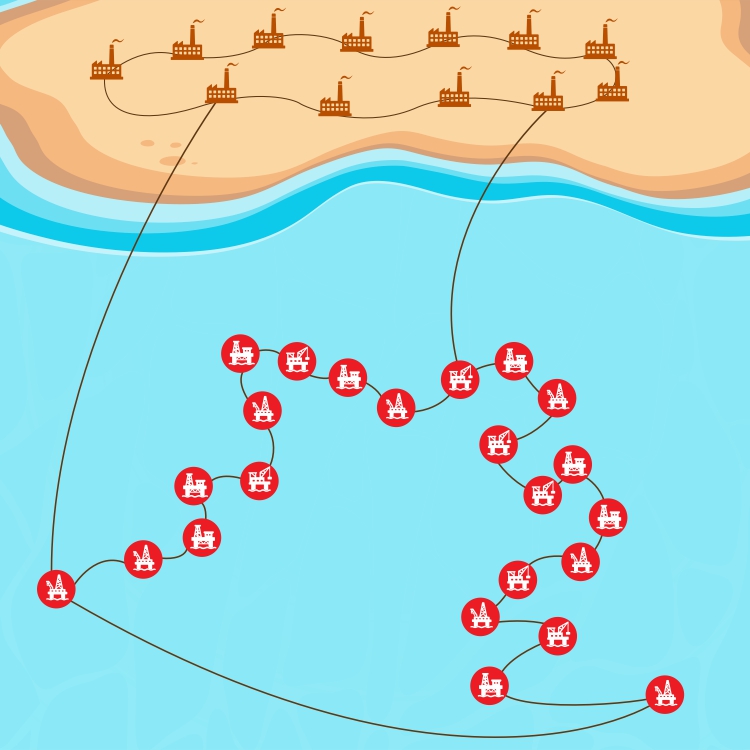
Dutch offshore activity is characterised by a large number of comparatively small gas installations rather than a handful of major hubs, and by an operating model built around remote control from shore. That model sets the engineering brief: redundant and diverse shore-to-platform transmission, radio and satellite backup that genuinely fails over, remote access to safety and control systems, and CCTV and public address coverage that lets an onshore operator understand and address an installation nobody is standing on. Regulation is administered under the Mining Act with State Supervision of Mines (SodM) as the offshore safety and environmental regulator, and hazardous-area equipment follows the European ATEX regime alongside IEC 60079. Layered over this is the energy transition: production is in structural decline, decommissioning is a growing workload, platform electrification is being pursued to cut emissions, and existing structures are being evaluated for offshore wind tie-in, hydrogen production and CO2 storage. Each of those changes what a platform is for — and each requires the communication, safety and control systems to be reworked, re-integrated and re-documented while the asset keeps producing.
What we deliver in Netherlands
Integrated telecom, safety and control-system engineering aligned with Netherlands’s oil & gas operations.
A dependable telecom partner in Netherlands
Related projects
Representative programmes that demonstrate the same engineering and integration capability.

Offshore Gas Telecom Systems in Netherlands — questions answered
Direct answers to common questions from project and procurement teams.
What telecom services does Exctel provide for Dutch North Sea operations?
Exctel provides shore-to-platform transmission and radio design, satellite and backup link engineering, SCADA and telemetry networks, PA/GA and emergency communications, CCTV and access control, and the telecom surveys and upgrade studies needed to keep ageing installations dependable — for offshore gas platforms and their onshore control and support facilities.
How does Exctel engineer telecom for normally unattended installations?
The design assumption is that nobody is on board to intervene. That means diverse transmission paths rather than a single link, failover that is proven by test rather than declared on a drawing, remote access to safety and control systems with the cyber controls that implies, and CCTV and public address coverage sufficient for an onshore operator to assess and respond to a situation remotely. Availability is treated as a design requirement with a number attached, not an aspiration.
Can Exctel support platform electrification and repurposing projects?
Yes. Electrifying a platform, tying it to offshore wind, or repurposing it for hydrogen or CO2 storage changes its power, control and communication architecture — usually while the asset is still operating. Exctel surveys what is actually installed, engineers the revised telecom and safety systems around the new configuration, and re-documents the result, drawing on delivery experience across both oil and gas and renewable energy projects.
Does Exctel handle obsolescence on ageing Dutch offshore installations?
Yes. Long-serving gas installations accumulate obsolete equipment, unavailable spares and modifications that never reached the drawings. Exctel surveys the as-installed condition, assesses it against current requirements, and engineers a staged replacement that fits the limited offshore access and campaign windows typical of unattended assets — leaving accurate documentation behind.
Why choose Exctel for offshore gas telecom systems in the Netherlands?
Exctel brings 25+ years of international oil & gas telecom experience, a focus on integrating telecom with safety and control systems rather than delivering them in isolation, brownfield capability for work on producing assets, and vendor independence — which matters on a basin where most scope is upgrading, electrifying or repurposing what already exists rather than building new.
Industries we serve here
Other locations we serve
Planning offshore gas telecom systems in Netherlands?
From feasibility to commissioning, our engineers are ready to help you deliver safe, connected and future-ready infrastructure.